How many restrooms does a county fair need in Costa Mesa?
Start with worker counts, then layer in attendance separately, because fairgrounds staff and fairgoers are two different populations with two different rules. OSHA 1926.51(c) sets the construction-industry baseline: one toilet for 20 workers or fewer, then one toilet seat and one urinal per 40 workers once you pass that line, scaling again at 200. That's the standard we use for vendor crews, setup labor and security staff working the grounds before gates open. Public attendance is a different math problem entirely, driven by peak-hour headcount rather than a flat ratio, and our how many porta potties do I need guide walks through both sides so organizers aren't guessing. Most fair layouts land on a mix of standard portable toilet rental units for general use, a cluster of ADA accessible porta potty units near main walkways, and at least one deluxe flushable porta potty option near VIP or sponsor areas. ADA Standards 213.2 requires at least 5 percent of clustered single-user units to be accessible, never fewer than one, so a bank of twenty standard units needs at least one ADA unit sitting right alongside it, not tucked around a corner. If the fair runs food vendors under open flame or fryers, that's a separate conversation covered in our handwashing station requirements page, since 29 CFR 1910.141(d)(2) requires soap and towels or a hand-drying device at washing stations, not sanitizer alone.
What restroom setup works best for a multi-day county fair?
Multi-day fairs need a servicing rhythm, not just a delivery count, because tanks fill fast under sustained public use. A standard unit holds 60 to 70 gallons before it needs pumping, and ANSI/PSAI Z4.3 sets a baseline of one service visit per week for up to 10 users across a standard 40-hour week, a pace that a fairground blows through in a single day. That's why our fair contracts build in multiple daily service passes, not the once-a-week default. For grounds with large public turnout, we typically recommend clustering portable restroom rental units in banks near entrances and food courts rather than spreading them thin across the lot, since foot traffic concentrates near the gates and midway. Larger fairs in Costa Mesa often add an 8 stall restroom trailer or 4 stall restroom trailer near grandstand seating, giving attendees a flush-toilet option with running water instead of a standard unit. A restroom trailer rental also helps with evening events when lighting and ADA route width matter more, since ADA Standards 403.5.1 requires a 36 inch clear accessible route and 404.2.3 sets minimum door width at 32 inches, both of which trailers meet more comfortably than a cluster of standalone units on packed dirt.
Where should restrooms go on the fairgrounds?
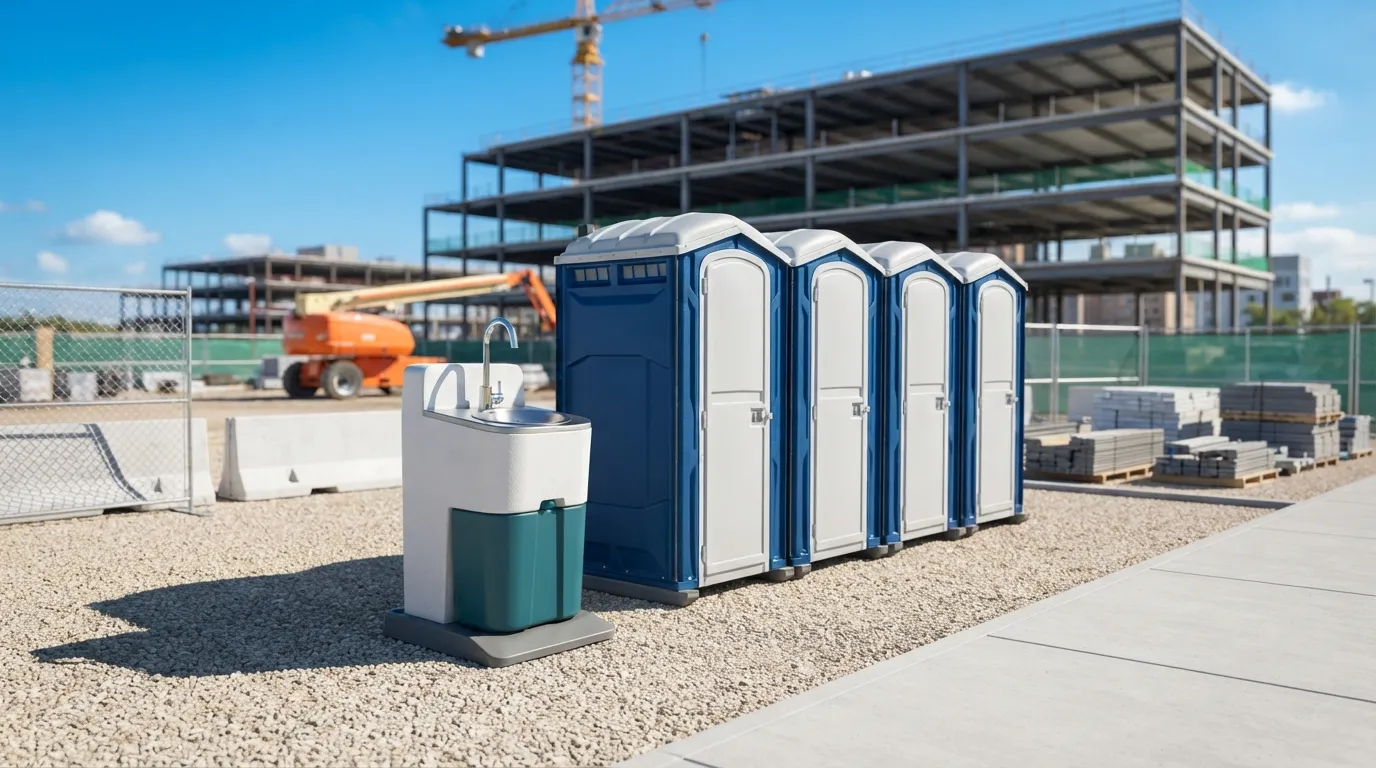
Placement decides whether restrooms feel five minutes away or fifty. Units belong on stable, firm, slip-resistant ground per ADA Standards 302.1, so gravel lots or mowed turf work better than loose dirt that shifts under foot traffic. Keep a 60 inch turning circle clear in front of every ADA unit per ADA Standards 304.3.1, and make sure door hardware needs no more than 5 pounds of force per ADA Standards 309.4, since fairgoers juggling strollers or funnel cake don't have a free hand to fight a latch. Our porta potty placement guide covers sight lines, lighting and distance from food booths in more depth. If the fairgrounds sit within city right-of-way or shared parking areas, placement in the public right of way needs confirming with the city before delivery, so check with Costa Mesa before finalizing your layout. We also stage temporary fence rental or crowd control barrier rental around restroom clusters when queue management matters, and pair sanitation stops with handwashing station rental units nearby. Fairs drawing crowds from Stanton, roughly 12.8 miles northwest, or Aliso Viejo, about 14.0 miles southeast, should plan delivery timing around regional traffic, and our service areas page covers routing across that broader radius.
| unit | duration | typical price |
|---|---|---|
| standard | event | $400 |
| ada | week | $185 |
| trailer | event | $3,500 |
| deluxe | week | $250 |
Pricing above reflects measured event and weekly bands; see porta potty rental cost for daily and monthly detail, or restroom trailer rental cost for trailer specifics.
How far in advance should we book fair restrooms?
Book as early as your vendor contracts allow, ideally 60 to 90 days out for a fair-scale event. Restroom trailers and ADA units book up fastest for peak fair season. Submit a request a quote early so we can lock trailer inventory before another Costa Mesa event claims it.
Do county fairs need ADA-compliant restrooms?
Yes. ADA Standards 213.2 requires at least 5 percent of clustered portable units to be accessible, never fewer than one, wherever standard units are grouped. See our ADA restroom requirements page for full spacing and route rules.
How often are fair restrooms serviced?
Multiple times daily during peak fair hours, well beyond the once-weekly baseline suggested by ANSI/PSAI Z4.3 for light use. High-traffic events need same-day pump-outs to keep tanks under the 60 to 70 gallon limit. Details are on our how often are porta potties cleaned page.
Can we add restroom trailers instead of standard units?
Yes. A 2 stall restroom trailer or larger works well near grandstands or VIP zones, offering flush toilets and running water. Trailers need level, stable ground and clear access for delivery and pumping trucks.
What if we need extra units added mid-event?
Call us and we'll deliver more the same day when possible. Our emergency porta potty rental service covers unexpected crowd surges. Keep our contact info on hand through contact for fast fair-day response.
Next step
Get a delivery date
Tell us the address, the dates and the headcount. We size the order and confirm the route.